
Versus Engine
GMKtec EVO-X2 (128GB) vs Radeon RX 9070
Specs, price and the one trade-off that actually decides it — GMKtec EVO-X2 (128GB) against Radeon RX 9070, side by side.
Cheaper to start
Tie
Both start at a similar price.
Rated higher
GMKtec EVO-X2 (128GB)
8.0 vs 0.0 on our design scale.
Standout
GMKtec EVO-X2 (128GB)
128GB massive memory pool
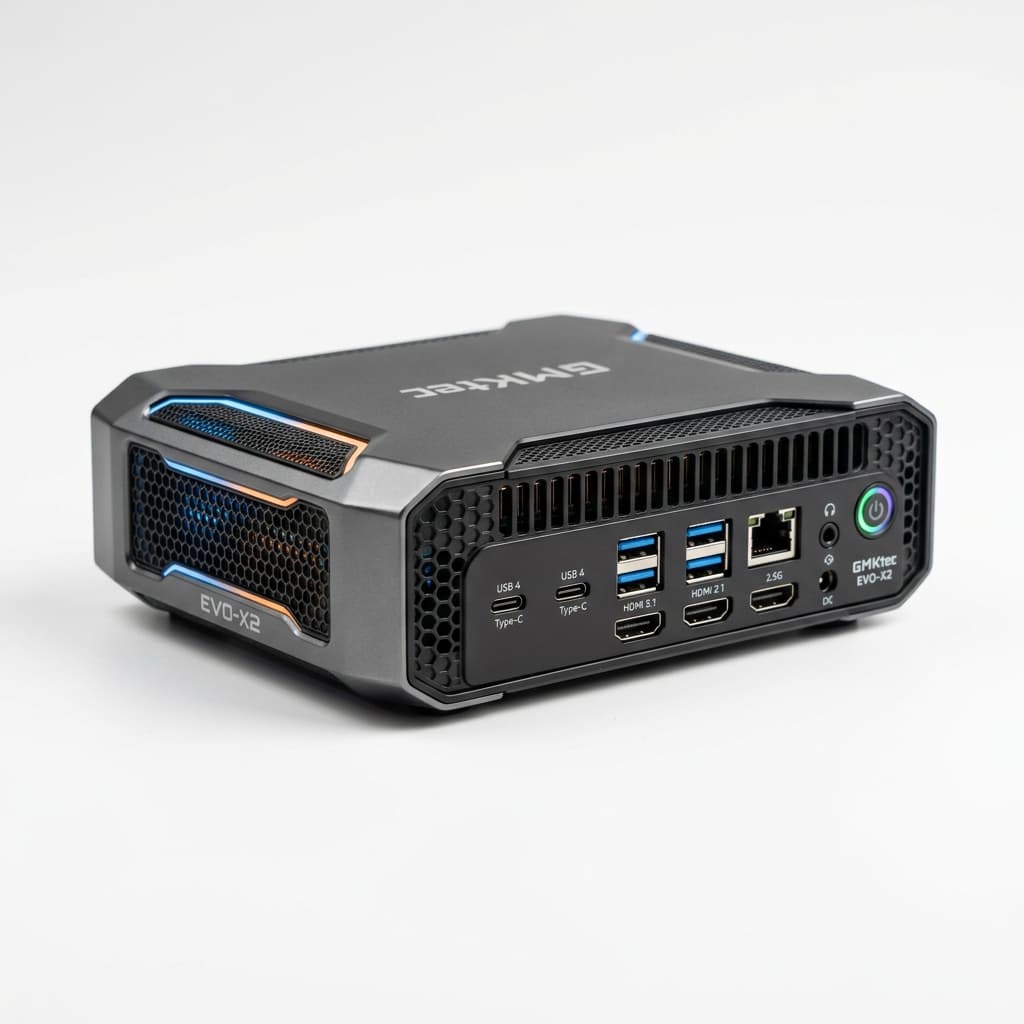
GMKtec EVO-X2 (128GB)
Enthusiast-tier mini workstation: AMD Ryzen AI Max+ 395 with 128 GB of unified memory. Runs Llama 3.3 70B and Mistral Small 3.1 at roughly 15-25 tokens/s — 70B-class models without a discrete GPU, in a small-form-factor chassis.
Where it wins, where it doesn't
Pros
- 128GB massive memory pool
- Ultra-compact form factor
- Dual NVMe storage slots
Cons
- APU graphics bottleneck token generation speed
- Audible fan noise under sustained load
Specifications
- displayportDisplayPort 1.4 ×1, up to 8K@60Hz
- hdmiHDMI 2.1 ×1, up to 8K@60Hz
- memory_speed8000MHz
- achievable frequency—
- ai accelerators—
- ai_npuBased on AMD XDNA 2 architecture; AI TOPS performance varies by application, model, and settings
- Architecture—
- audio3.5mm headphone / audio jack ×1
- bluetoothBluetooth 5.4
- Board Design / Outputs—
- Board Design / Power Connectors—
- Board Design / Suggested PSU—
- Board Design / TDP—
- Bus Interface—
- bus type—
- chipAMD Ryzen AI Max+ 395
- Chip Package—
- Clock Speeds / Base Clock—
- Clock Speeds / Boost Clock—
- Clock Speeds / Game Clock—
- Clock Speeds / Memory Clock—
- Density—
- Die Size—
- dimensionsApproximately 186 × 77 × 192 mm
- display_outputHDMI 2.1 ×1, DisplayPort 1.4 ×1, USB4 ×2, supports up to 8K@60Hz display output, actual output depends on display, cables, and settings
- example_modelsLlama 3.3 70B, Mistral Small 3.1
- features—
- Foundry—
- game frequency—
- Generation—
- gpu memory—
- GPU Name—
- GPU Variant—
- Graphics Card—
- Graphics Features / OpenCL—
- Graphics Features / OpenGL—
- Graphics Features / Vulkan—
- Matrix Performance / BF16—
- Matrix Performance / INT4—
- Matrix Performance / INT8—
- Matrix Performance / Sparse Matrix—
- max memory size—
- memory128GB LPDDR5X 8000MHz
- Memory / Bandwidth—
- Memory / Memory Bus—
- Memory / Memory Size—
- memory bandwidth—
- memory interface—
- memory type—
- memory_capacity128GB LPDDR5X
- memory_formOnboard LPDDR5X, typically not user-upgradeable
- nameGMKtec EVO-X2 AMD Ryzen AI Max+ 395 128GB RAM + 2TB SSD Windows 11 Pro Mini PC 2 years warranty (CS-GEVOX2)
- Navi 48 GPU Notes—
- Numeric Format Support / Matrix—
- Numeric Format Support / Vector—
- operating_systemWindows 11 Pro
- Package Size—
- peak 4-bit precision (int4 matrix) performance—
- peak 8-bit precision (fp8 matrix) performance (e5m2, e4m3)—
- peak 8-bit precision (int8 matrix) performance—
- peak half precision (fp16 matrix) performance—
- peak half precision (fp16 vector) performance—
- peak pixel fill-rate—
- peak single precision (fp32 vector) performance—
- Predecessor—
- preloaded_storage2TB M.2 2280 SSD
- Process Size—
- Process Type—
- processorAMD Ryzen™ AI Max+ 395, 16 cores / 32 threads, up to 5.1GHz
- ray accelerators—
- Render Config / L0 Cache—
- Render Config / L2 Cache—
- Render Config / L3 Cache—
- Render Config / Matrix Cores—
- Render Config / RT Cores—
- Render Config / Shading Units—
- Render Config / TMUs—
- rops—
- sd_card_readerSome official / retail data indicates SD Card Reader, actual shipping version varies
- skuCS-GEVOX2
- storage2TB M.2 2280 SSD; up to 2 M.2 2280 slots for expansion, actual capacity depends on SKU and hardware support
- storage_expansionUp to 2 M.2 2280 slots; expansion limit depends on actual unit and manufacturer data
- stream processors—
- Successor—
- supported rendering format—
- Theoretical Performance / FP16—
- Theoretical Performance / FP32—
- Theoretical Performance / FP64—
- Theoretical Performance / Pixel Rate—
- Theoretical Performance / Texture Rate—
- tierenthusiast
- tokens_per_second15-25
- transistor count—
- Transistors—
- typical board power (desktop)—
- unified_memory_gb128
- usb_aUSB 3.2 ×3, USB 2.0 ×2
- warranty2 years
- wired_network2.5G LAN ×1
- wireless_networkWi-Fi 7
Radeon RX 9070
Radeon RX 9070 graphics card with up to 2520 MHz achievable frequency and 16 GB GDDR6 memory
Where it wins, where it doesn't
Pros
- Achievable frequency of up to 2520 MHz
- 16 GB of GDDR6 memory
- Up to 640 GB/s memory bandwidth
Cons
- Requires a minimum PSU of 650W
- High typical board power of 220W
Specifications
- displayport2.1a
- hdmi2.1b
- memory_speedUp to 20 Gbps
- achievable frequencyUp to 2520 MHz
- ai accelerators112
- ai_npu—
- ArchitectureRDNA 4
- audio—
- bluetooth—
- Board Design / Outputs1x HDMI 2.1b, 3x DisplayPort 2.1a
- Board Design / Power Connectors2x 8-pin
- Board Design / Suggested PSU550 W
- Board Design / TDP220 W
- Bus InterfacePCIe 5.0 x16
- bus typePCIe® 5.0 x16
- chip—
- Chip PackageHFCBGA-2069
- Clock Speeds / Base Clock1330 MHz
- Clock Speeds / Boost Clock2520 MHz
- Clock Speeds / Game Clock2070 MHz
- Clock Speeds / Memory Clock2518 MHz
- Density151.0M / mm²
- Die Size357 mm²
- dimensions—
- display_output—
- example_models—
- featuresAMD Software Adrenalin Edition, AMD Fluid Motion Frames, AMD Noise Suppression, AMD Radeon™ Super Resolution, AMD Smart Access Memory, AMD Smart Access Video, AMD Privacy View, AMD Radeon™ Boost, AMD Radeon™ Anti-Lag, AMD Radeon™ Image Sharpening, AMD Enhanced Sync Technology, AMD FreeSync™ Technology, AMD Radeon™ Chill, AMD Virtual Super Resolution, AMD FSR™ 'Redstone'
- FoundryTSMC
- game frequency2070 MHz
- GenerationNavi IV
- gpu memoryAMD Infinity Cache Technology
- GPU NameNavi 48
- GPU VariantNavi 48 XT
- Graphics CardRX 9000
- Graphics Features / OpenCL2.0
- Graphics Features / OpenGL4.6
- Graphics Features / Vulkan1.4
- Matrix Performance / BF16144.5 TFLOPS
- Matrix Performance / INT4578.0 TOPS
- Matrix Performance / INT8289.0 TOPS
- Matrix Performance / Sparse Matrix2x Throughput
- max memory size16 GB
- memory—
- Memory / Bandwidth644.6 GB/s
- Memory / Memory Bus256 bit
- Memory / Memory Size16 GB
- memory bandwidthUp to 640 GB/s
- memory interface256-bit
- memory typeGDDR6
- memory_capacity—
- memory_form—
- name—
- Navi 48 GPU NotesSuper Resolution: FSR 4.1.2, XeSS 3, Frame Generation: FSR 4.0.2, XeSS 3, Ray Regeneration: FSR 1.2.1, Radiance Caching: FSR 0.9.0 (Technical Preview), Compute Units: 4th Gen, Ray Tracing: 3rd Gen, Infinity Cache: 3rd Gen, AI Accelerators: 2nd Gen, Radiance Display Engine: 2nd Gen, Shader ISA: GFX12.0 (gfx1201), Graphics/Compute: 12.0.1, Display Core Next: 4.0.1, Video Core Next: 5.0.0, JPEG Engine: 5.0.0
- Numeric Format Support / MatrixINT1, INT2, INT4, INT8, MXFP4, NVFP4, MXFP6, FP8, MXFP8, FP16, BF16, FP32, TF32, FP64
- Numeric Format Support / VectorINT4, INT8, INT16, INT32, FP16, BF16, FP32, FP64
- operating_system—
- Package Size45 mm × 35 mm
- peak 4-bit precision (int4 matrix) performance578 TOPs
- peak 8-bit precision (fp8 matrix) performance (e5m2, e4m3)289 TFLOPs
- peak 8-bit precision (int8 matrix) performance289 TOPs
- peak half precision (fp16 matrix) performance145 TFLOPs
- peak half precision (fp16 vector) performance36.1 TFLOPs
- peak pixel fill-rateUp to 322.6 GP/s
- peak single precision (fp32 vector) performance36.1 TFLOPs
- PredecessorNavi III
- preloaded_storage—
- Process Size4 nm
- Process TypeN4P FinFET
- processor—
- ray accelerators56
- Render Config / L0 Cache32 KB per CU
- Render Config / L2 Cache8 MB
- Render Config / L3 Cache64 MB
- Render Config / Matrix Cores112
- Render Config / RT Cores56
- Render Config / Shading Units3584
- Render Config / TMUs224
- rops128
- sd_card_reader—
- sku—
- storage—
- storage_expansion—
- stream processors3584
- SuccessorAlpha Trion
- supported rendering formatHDMI™ 4K Support, 4K H264 Decode, 4K H264 Encode, H265/HEVC Decode, H265/HEVC Encode, AV1 Decode, AV1 Encode
- Theoretical Performance / FP1636.13 TFLOPS (1:1)
- Theoretical Performance / FP3236.13 TFLOPS
- Theoretical Performance / FP641.129 TFLOPS (1:32)
- Theoretical Performance / Pixel Rate322.6 GPixel/s
- Theoretical Performance / Texture Rate564.5 GTexel/s
- tier—
- tokens_per_second—
- transistor count53.9 B
- Transistors53.9 billion
- typical board power (desktop)220W
- unified_memory_gb—
- usb_a—
- warranty—
- wired_network—
- wireless_network—